Signal From the Block: Inside the Hyper-Local Podcast Scenes Big Tech Can't Touch
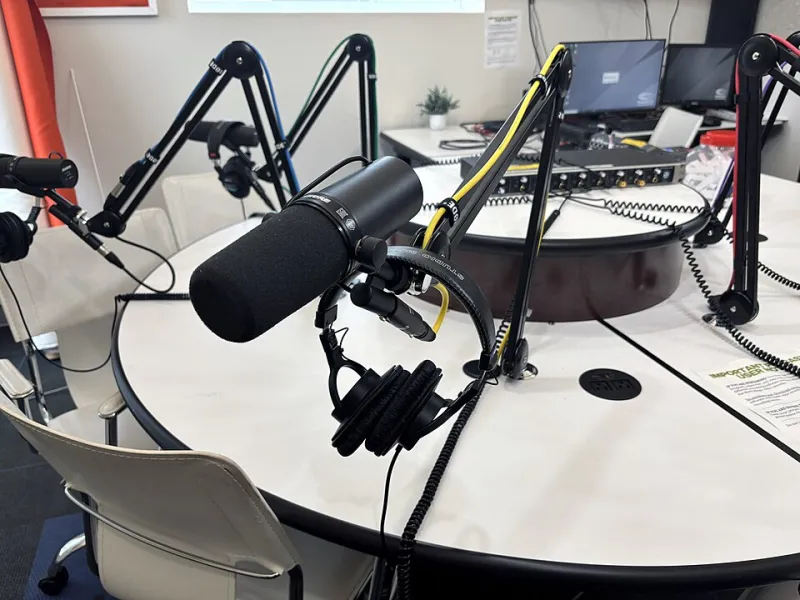
Photo: Myotus, CC BY 4.0, via Wikimedia Commons
There's a podcast out of Albuquerque that covers nothing but the history of individual city blocks — one block per episode, oral histories and property records and the stories of businesses that came and went. It has maybe four hundred regular listeners. Its host, a retired city planner named Rosario, records in her living room on a mid-range condenser mic and distributes through a bare-bones RSS feed that she updates manually. Spotify has never suggested it to anyone. She couldn't care less.
"The people who listen to it," she says, "they're the people who live here. They recognize the street names. They remember the bakery I'm talking about. That's not a small thing. That's actually the whole thing."
Rosario's show is part of something that doesn't have a clean name yet — a loose, decentralized movement of podcast creators who are deliberately building for small, specific audiences rather than chasing the scale that platforms like Spotify and Apple Podcasts are structured to reward. Call it hyperlocal audio. Call it community radio's weird digital grandchild. Whatever you call it, it's thriving in the gaps that algorithmic culture leaves behind.
The Anti-Discovery Model
Mainstream podcast culture is built around discoverability. Platform algorithms surface shows based on download numbers, engagement metrics, and advertising potential. The system rewards broad appeal, consistent output, and the kind of topic selection that can be described in a pitch deck. It's not a bad system if you're trying to build a media company. It's a terrible system if you're trying to make something for your neighborhood.
Hyperlocal podcasters have largely stopped fighting that system and started ignoring it entirely. Distribution through major apps is often an afterthought, if it happens at all. Instead, these shows spread through community Facebook groups, local subreddits, email newsletters, flyers at coffee shops, and — in a genuinely surprising number of cases — partnerships with community radio stations that broadcast the audio over FM and stream it through their own platforms.
The community radio connection is particularly interesting. Stations that operate under LPFM licenses (low-power FM, a category the FCC expanded significantly in 2013) have become unexpected incubators for this kind of audio content. A station in a mid-sized Midwestern city might carry a podcast about local jazz history during its overnight programming, reaching an audience that never downloaded a podcast app in their lives.
What Gets Covered
The subject matter in this space tends to cluster around things that have no natural home in mainstream media. Regional folklore is a big one — shows dedicated to the ghost stories, urban legends, and local mythology of specific places, the kind of material that's too granular for a national true-crime network but endlessly compelling to people who grew up with those stories.
Neighborhood history is another consistent theme. Cities across the US contain entire worlds of historical complexity that never make it into the tourism brochures — the history of redlining in a specific zip code, the story of a particular immigrant community's settlement patterns, the oral histories of longtime residents in neighborhoods undergoing gentrification. These are stories that local newspapers once covered and increasingly don't, and podcasters are filling the vacuum with genuine depth.
Then there's the music coverage. This is where things get genuinely interesting from a SubStrata perspective. Local music scenes — the actual, functioning underground scenes in mid-sized American cities — are almost entirely invisible to national music media. A podcast based in Richmond, Virginia that covers the local hardcore scene, or one out of Kansas City documenting the city's jazz revival, isn't competing with Pitchfork. It's doing something Pitchfork can't do: it's talking to the people who were at the show last Saturday, and it's talking to them about what happened.
"We cover shows that had maybe eighty people at them," says the host of a music podcast based in Olympia, Washington. "But those eighty people are the scene. If you want to understand what's actually happening in this city musically, you have to talk to those eighty people, not wait for someone in New York to notice."
The Technical Reality
Running a hyperlocal podcast network on limited resources requires creative infrastructure. Many of these operations rely on free or low-cost hosting through services like Anchor (now Spotify for Podcasters, which creates its own ideological complications), Buzzsprout, or self-hosted solutions using open-source software on cheap server space.
Some networks have pooled resources to share hosting costs and technical infrastructure across multiple shows. A collective in the Pacific Northwest runs six different local-interest podcasts under a shared umbrella, splitting hosting fees and cross-promoting across their combined audience of a few thousand listeners. None of the individual shows would be viable in isolation. Together, they function like a tiny public radio network.
The RSS feed — the open, platform-agnostic distribution standard that the podcast ecosystem was originally built on — has become something of a political statement in this context. Choosing RSS over exclusive platform distribution is a deliberate rejection of the walled garden, a commitment to the idea that audio should be as open as text on a webpage. There's a small but vocal contingent of hyperlocal podcasters who refuse to distribute through Spotify on principle, viewing the platform's exclusivity deals and algorithmic controls as fundamentally incompatible with what they're trying to build.
Who's Listening
The audiences for these shows are genuinely different from mainstream podcast listeners in ways that go beyond just geography. The relationship between creator and listener tends to be more direct and more reciprocal. Listeners show up to events. They submit tips and story ideas. They argue with hosts in comment sections and at local meetups. The feedback loop is tight in a way that's almost impossible to maintain at scale.
This intimacy has its own appeal, and not just for the listeners. Several of the creators interviewed for this piece mentioned that the directness of their audience relationship is what keeps them going through the unglamorous logistics of independent audio production. When you know that the person who emailed you about last week's episode is your neighbor's former coworker, the whole enterprise feels different.
"I've had national podcasts reach out about collaborating," says one host of a New Orleans-focused folklore show. "And I've said no every time. Not because I don't appreciate it. Because the moment I'm making something for people who don't know what banquette means, I'm making something different. I'm not interested in making something different."
The Fragmentation Is the Point
From the outside, the hyperlocal podcast world can look like a failure to scale — a collection of tiny, underfunded operations that never broke through. That framing misses what's actually happening. These shows aren't trying to break through. They're trying to stay put.
In a media environment where every platform is optimizing for global reach and maximum engagement time, there's something genuinely radical about making audio for four hundred people who all live within twenty miles of each other. It's not a stepping stone. It's a destination.
The signal stays local. That's the whole design.