Clack and Release: Why a Growing Cult of Writers Is Trading Cursor Blink for Mechanical Thunder
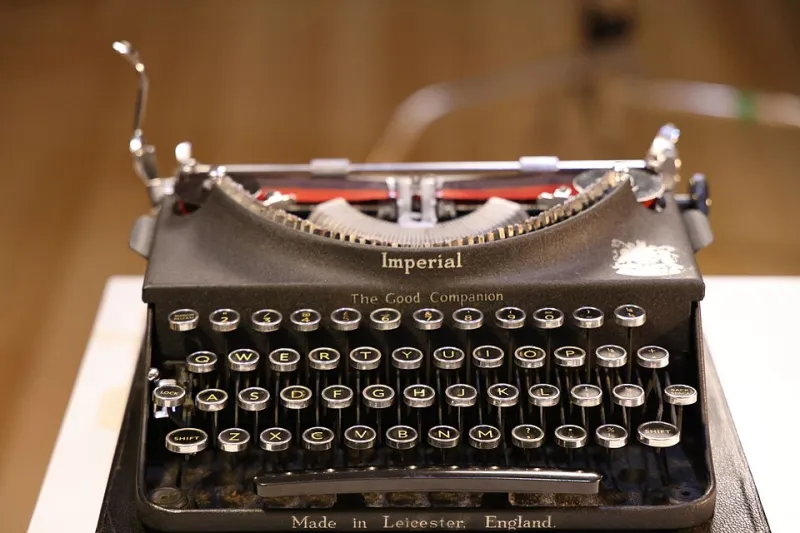
Photo: Bhullargraphic, CC BY-SA 4.0, via Wikimedia Commons
There's a particular sound that comes out of Marcy Delgado's apartment in Albuquerque every morning around six. Her neighbors know it. Her cat has learned to ignore it. It's the sound of a 1963 Hermes 3000 doing exactly what it was designed to do — converting intention into permanent, ink-stamped reality, one irreversible keystroke at a time.
Marcy isn't a hobbyist. She's a working journalist who covers local politics and, until three years ago, filed everything from a MacBook Pro like a normal person. Then she bought the Hermes on a whim at an estate sale for forty bucks, and something in her brain rewired itself.
"The first draft I did on it was terrible," she says. "But it was honestly terrible. There was no revision anxiety, no going back and polishing a sentence seventeen times before I'd even finished the thought. The machine just doesn't let you do that. You move forward or you stop."
Marcy is far from alone. Across the country, a quietly expanding community of novelists, journalists, poets, and general-purpose word people have made the deliberate choice to pull back from screens and return to the mechanical keyboard's older, louder, substantially more committed ancestor. It's a subculture that operates mostly below the radar — you won't find a major brand sponsoring it, and there's no app to track your typewriter sessions — but its energy is real, and its reasoning is sharper than the "vintage aesthetic" dismissal it usually gets from the outside.
The Machine That Pushes Back
Ask any committed typewriter user what first hooked them and they'll almost always reach for the same word: resistance. Not resistance in the political sense, though that framing isn't entirely absent from the conversation. Physical resistance. The weight of the keys, the force required to register a letter, the mechanical consequence of every decision.
Digital writing is frictionless by design. That's the whole pitch — remove every obstacle between thought and text. But a growing number of writers have started to argue that friction isn't the enemy. That the slight muscular effort of a typewriter keystroke creates a cognitive loop that slows the brain down just enough to actually think before committing.
There's some legitimate neuroscience lurking behind this intuition. Studies on handwriting versus typing have long suggested that the physical act of forming letters engages different cognitive pathways than tapping a flat keyboard. Typewriter advocates argue their machines occupy a middle ground — faster than longhand, but meaningfully more embodied than a laptop.
Phil Okafor, who writes speculative fiction out of Detroit and has published three novels, puts it this way: "A laptop is a portal to everything. A typewriter is a room with one door. You go in, you write, you come out. That's the whole deal."
The Market Nobody Expected to Survive
Here's the economic reality that surprises most people when they first encounter this world: vintage typewriters are not cheap anymore, and they haven't been for a while.
A decade ago, you could routinely find fully functional machines at Goodwill for under twenty dollars. Those days are essentially over in most American cities. The used typewriter market has been quietly inflating since the early 2010s, accelerated by a combination of Tom Hanks publicly evangelizing his collection, a wave of design-conscious millennials discovering the machines, and a genuine contraction in available supply as working units become harder to find.
Today, a clean Royal Quiet De Luxe or Olivetti Lettera 32 — two of the most coveted portable models — will run anywhere from $150 to $400 depending on condition and seller. Rarer machines like the Hermes 3000 or a well-maintained IBM Selectric can push past $600 without breaking a sweat. Repair technicians, once a dying profession, are now booking out weeks in advance in cities like Portland, Chicago, and Brooklyn.
Online communities — particularly the subreddit r/typewriters and the Typewriter Talk forums — function as informal price guides, repair advice hubs, and collective enthusiasm engines. Members share "type samples" the way audiophiles post speaker measurements. They debate the merits of specific ribbon brands with the seriousness of vinyl heads arguing cartridge alignment.
What's interesting is that the market hasn't been captured by a single dominant retailer or brand. It remains genuinely fragmented — estate sales, antique malls, eBay, local Facebook Marketplace listings, and a handful of specialty shops like Philadelphia's Gramercy Typewriter or the legendary Cal's Typewriters in New York. That decentralization is part of what keeps the community feeling underground rather than commodified.
Workflow or Theater?
The honest question that hangs over all of this is whether typewriter writing actually produces better work, or whether it's an elaborate ritual that makes writers feel more serious without the output to back it up.
The community itself is divided, which is one of the things that makes it interesting. There are true believers who insist the machine has fundamentally changed how they write — more decisive sentences, less overthinking, a different relationship to the first draft as a raw material rather than a finished product. And then there are people who will cheerfully admit they type on a Royal Quiet De Luxe for maybe an hour a week and then transcribe everything into Scrivener anyway, but that hour feels good so they keep doing it.
Both positions are valid, and the tension between them is actually pretty generative. The typewriter functions differently depending on what you need it to do. For some writers it's a primary tool. For others it's a reset button — a way to break a block, change the sensory context of composition, or simply spend time away from a screen that is also, always, simultaneously an inbox and a social feed and a news ticker.
Marcy Delgado doesn't romanticize it. "I still file on a computer. I'm not sending my editor typewritten pages through the mail. But the first draft lives on paper, and that changes everything downstream. You can't ctrl-Z your way out of a bad sentence. You have to live with it long enough to understand why it's bad."
Permanence in a Delete-Everything Age
There's something else happening here that goes beyond workflow optimization, and it connects directly to the broader cultural moment these writers are responding to. We live in an environment of radical impermanence — content deleted, accounts suspended, platforms shuttered, files corrupted. The digital record is simultaneously everywhere and nowhere.
A page typed on a 1963 Hermes 3000 will still be readable in 2123. The typewriter community, whether it consciously frames it this way or not, is making an argument for permanence. For the value of a document that exists in physical space, that can be held and smelled and stored in a drawer.
That's not nostalgia. That's a considered response to the specific anxieties of writing in an age when everything can be erased with a single bad backup.
The machines clack on. The neighbors learn to live with it.